

close
Choose Your Site
Global
Social Media
Views: 0 Author: Site Editor Publish Time: 2026-08-21 Origin: Site


Procuring industrial stainless pipe fittings is never merely a commodity purchase. You must treat it as a critical risk-management decision. Choosing incorrect specifications inevitably leads to severe system failures. Leaks compromise facility safety, premature corrosion degrades expensive infrastructure, and unexpected downtime drains operational budgets rapidly. Matching a seemingly simple pipe component to complex piping systems involves strict technical alignment. You must evaluate fluid media, pressure demands, and harsh environmental factors simultaneously. Ignoring these variables introduces hidden vulnerabilities into your fluid networks.
This comprehensive guide provides an objective, reliable framework for your engineering and procurement teams. Professionals will learn how to evaluate exact specifications effectively. We will help you select the exact right components while keeping project expenditures strictly under control. You will gain actionable insights on material selection, wall thickness, thread compliance, and vendor verification. Following these guidelines ensures your piping infrastructure remains robust, safe, and continuously operational.
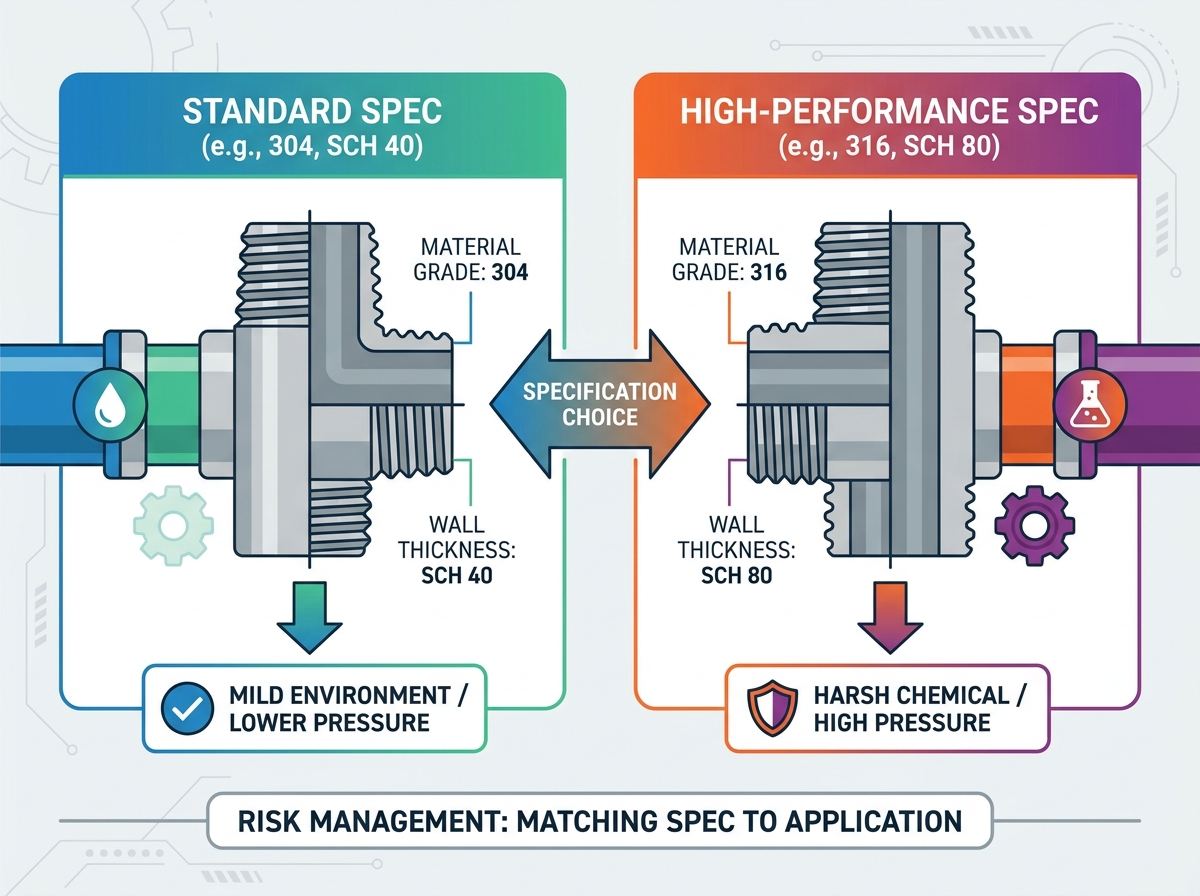
Material selection (304 vs. 316) must align strictly with the chemical exposure of the environment to balance cost and longevity.
Pipe schedule (thickness) dictates pressure capacity; over-specifying schedule 80 when schedule 40 suffices creates unnecessary weight and cost.
Thread mismatch (e.g., NPT vs. BSPT) is a primary cause of system failure and joint leaks.
Partnering with a certified stainless steel threaded nipple manufacturer ensures proper material traceability and compliance with global standards (like EN10241).
Material grade forms the foundation of any piping system. Engineers primarily choose between two dominant austenitic stainless steel grades. Understanding their chemical differences prevents catastrophic corrosion failures.
Industry professionals consider 304 stainless steel the standard baseline for general applications. It contains approximately 18% chromium and 8% nickel. This specific chemical makeup provides excellent oxidation resistance. It handles neutral water, compressed air lines, and mild chemicals perfectly. Its inherent cost-efficiency makes it highly popular for standard industrial fabrication. However, 304 possesses significant limitations. It remains highly susceptible to localized pitting when exposed to chlorides. You should never deploy 304 components in coastal areas or near de-icing salts.
When environments turn hostile, you must upgrade to 316 stainless steel. This grade adds 2% to 3% molybdenum to the alloy matrix. Molybdenum acts as a powerful deterrent against chloride-induced pitting. Certain bottom-of-the-funnel (BOFU) scenarios make 316 absolutely non-negotiable. Marine environments demand it. Harsh chemical processing plants require it. High-chloride exposure areas, such as wastewater treatment facilities, rely exclusively on it. While the upfront unit price is higher, 316 prevents rapid degradation in these aggressive settings.
You must evaluate long-term operational integrity rather than just upfront unit pricing. We recommend using the following simple framework to choose between 304/316 stainless steel pipe fittings.
Environmental Condition | Recommended Grade | Primary Justification |
|---|---|---|
Indoor, clean water, or compressed air | 304 Stainless Steel | Provides sufficient corrosion resistance while minimizing initial project costs. |
Outdoor, away from coastlines or road salts | 304 Stainless Steel | Handles standard atmospheric moisture and seasonal weathering effectively. |
Marine environments, coastal facilities | 316 Stainless Steel | Molybdenum prevents rapid chloride pitting from airborne sea salt. |
Chemical processing, acidic fluid media | 316 Stainless Steel | Resists aggressive chemical attacks and reduces long-term replacement frequency. |
Always verify the carbon content of your fittings. Look for "L" grade designations, such as 304L or 316L. The "L" indicates low carbon content. Low carbon prevents carbide precipitation during high-heat welding processes. This minor detail significantly preserves the metal's corrosion resistance at the weld seams.
Specifying the correct physical dimensions prevents catastrophic bursts and ensures smooth fluid flow. You must master the relationship between pipe size and wall thickness.
Procurement teams frequently fall into a common sizing trap. They measure the outside diameter (OD) and assume it equals the Nominal Pipe Size (NPS). This assumption is dangerously incorrect. NPS serves as a dimensionless designator. For example, a 2-inch NPS pipe does not measure exactly 2 inches across its outside diameter. The actual OD for a 2-inch NPS pipe is 2.375 inches. This mismatch causes severe procurement errors. You must consult standardized dimensional charts before placing orders. Measuring existing pipes requires specialized calipers and strict adherence to established engineering tables.
The "schedule" dictates the wall thickness of the pipe. It directly determines the component's internal pressure capacity.
Schedule 40 (Standard Weight): This schedule serves as the industry default. It balances structural integrity and material weight efficiently. You should specify Schedule 40 for low-to-medium pressure applications. It works perfectly for standard water distribution and low-pressure pneumatic systems.
Schedule 80 (Extra Heavy): This schedule features significantly thicker walls. It is designed specifically for high-pressure environments. You also need Schedule 80 for highly corrosive environments. Corrosive fluids gradually eat away internal material over time. The extra thickness provides a sacrificial safety margin.
Over-specifying schedule 80 when schedule 40 suffices creates unnecessary weight and inflates project costs. Conversely, mixing different schedules within the same pipeline introduces severe hydraulic risks. Transitioning from a thick-walled Schedule 80 nipple to a thinner Schedule 40 fitting creates an internal step. This sudden geometry change triggers flow turbulence. Turbulence accelerates localized erosion inside the pipe. Always maintain consistent internal diameters across your entire fluid network.
Thread specifications dictate how securely your piping components join together. Getting this wrong guarantees immediate system failure.
The industrial world relies primarily on two dominant taper thread standards. National Pipe Thread (NPT) dominates North American markets. British Standard Pipe Taper (BSPT) dominates Europe, Asia, and Oceania. They appear identical to the untrained eye, but they remain fundamentally incompatible.
NPT features a 60-degree thread angle. Its peaks and valleys are flattened. BSPT uses a 55-degree thread angle. Its peaks and valleys are rounded. Their thread pitches also differ across various nominal sizes. This creates a critical mechanical risk. Forcing an NPT nipple into a BSPT fitting destroys the threads immediately. It causes severe cross-threading. The joint will never seal properly, and dangerous leaks become inevitable under pressure.
You cannot rely on visual inspections alone to verify thread quality. You must demand compliance with strict dimensional and testing standards. ASTM A733 dictates exact dimensions, threading requirements, and material quality for pipe nipples. International projects often demand European specifications. We strongly recommend sourcing your components from an established EN10241 nipple supplier. Certified suppliers use calibrated thread gauges to guarantee absolute precision. They ensure your components meet strict international compliance mandates.
Stainless steel possesses a unique physical vulnerability called thread galling. The metal relies on a microscopic passive oxide layer for corrosion resistance. When you tighten two stainless threads together, friction strips this protective layer away. The raw metal surfaces contact each other directly under high pressure. They cold-weld instantly. This permanent seizing ruins both components.
You must implement standard prevention practices during installation. Never assemble dry stainless threads. We recommend wrapping the male threads tightly with high-density, nickel-infused PTFE tape. Apply a compatible anaerobic thread sealant paste over the tape. This dual-layer lubrication prevents friction and ensures a flawless, leak-proof seal.
The physical manufacturing process determines how well a component handles mechanical stress. You must select the right construction method for your specific operational parameters.
The choice between seamless and welded construction impacts both structural integrity and procurement budgets.
Welded Construction: Manufacturers roll flat steel strips into tubes and weld the seam longitudinally. Modern Electric Resistance Welding (ERW) techniques make these components highly reliable. Welded nipples are cost-effective. They are perfectly suitable for most standard industrial applications, including municipal water and low-pressure chemical transport.
Seamless Construction: Manufacturers extrude solid steel billets to create seamless pipes. This process completely eliminates the weld seam vulnerability. It creates a uniformly strong component. You must specify seamless construction for high-pressure lines. Critical-service lines requiring strict API or ASME B31.3 code compliance mandate seamless components. They handle extreme pressure surges without risking seam rupture.
Engineers specify different end finishes based on exact fabrication requirements. You must understand standard industry abbreviations to order correctly.
TBE (Threaded Both Ends): This remains the most common configuration. Manufacturers cut standard taper threads on both ends of the pipe. You use TBE nipples to connect two female threaded fittings directly.
TOE (Threaded One End): One end features standard threads. The other end remains completely plain and square-cut. You use TOE configurations for transitioning between different assembly methods. For example, welders attach the plain end to a welded piping network, leaving the threaded end exposed to attach a threaded valve.
PBE (Plain Both Ends): Both ends remain unthreaded. Manufacturers cut them square and deburr them carefully. You use PBE components exclusively for socket weld applications or specialized butt weld configurations.
Avoid ordering TOE nipples when you actually need a specialized bevel. Standard TOE components feature square-cut plain ends. If your welders require a precise 37.5-degree bevel for butt welding, you must specify BBE (Beveled Both Ends) or BOE (Beveled One End). Ignoring this detail forces welders to grind bevels manually on-site, wasting valuable labor hours.
Selecting the right vendor protects your entire piping system. You must audit potential suppliers rigorously before issuing purchase orders.
Do not accept verbal guarantees regarding material grades. You must demand hard documentation. Require Mill Test Reports (MTRs) for every single batch you purchase. An MTR provides the exact chemical breakdown and physical properties of the source steel. Furthermore, request Positive Material Identification (PMI) testing reports. PMI testing uses X-ray fluorescence devices to verify the alloy composition on the finished product. These steps verify you are actually getting the 304 or 316 grade you paid for.
A premier stainless steel threaded nipple manufacturer controls their entire production environment. Assess whether they handle raw material sourcing, pipe cutting, precision threading, and final passivation in-house. When a BSPT threaded fittings manufacturer outsources these steps, quality control breaks down. In-house processing guarantees strict adherence to dimensional tolerances and superior surface finishes.
Industrial projects rarely follow perfect standard dimensions. Evaluate the vendor's ability to supply non-standard lengths quickly. Ask if they can handle custom thread configurations, such as mixing NPT on one side and BSPT on the other. Finally, assess their inventory depth. A reliable supplier must fulfill large-volume runs without extending lead times unacceptably. Delays in pipe fitting delivery frequently halt entire construction projects.
Watch out for suppliers offering prices drastically below the market average. In the steel industry, you get exactly what you pay for. Unusually low prices often indicate the usage of recycled, inferior scrap metal. It might also indicate that the supplier skipped mandatory thread gauging procedures to speed up production. Installing cheap, out-of-tolerance components guarantees expensive leaks and immediate system shutdowns.
Specifying a reliable Stainless Steel Nipple requires balancing multiple technical variables. You must align material grades, wall thicknesses, and strict thread standards against your specific system demands. Treating this process as a critical engineering decision protects your facility from hazardous leaks and catastrophic downtime.
Before you request a quote, audit your current system requirements thoroughly. Verify your maximum operating pressure. Confirm the exact chemical nature of your fluid media. Check your existing piping networks to identify whether you need NPT or BSPT threads.
Do not leave these technical specifications to chance. Consult with your chosen vendor's engineering or sales team to review your exact requirements. Request MTR-backed samples to verify quality firsthand. Once you confirm their capabilities, secure a custom bulk quote to keep your project moving efficiently and safely.
A: You must measure it end-to-end. This measurement includes all threaded portions. Industry professionals refer to this as the Overall Length (OAL). Do not measure only the unthreaded central shank. Always specify the exact OAL when ordering to ensure proper fit within your piping assembly.
A: A close nipple features continuous threads across its entire length. It lacks an unthreaded central shank completely. You should avoid it in high-torque assemblies. Installers must grip the threads directly with a pipe wrench to tighten it. This grip crushes the threads and invites severe leakage.
A: We strongly advise against this practice. Mixing dissimilar metals in fluid systems triggers galvanic corrosion rapidly. The less noble metal will degrade, rust, and fail. This causes catastrophic joint failure over time. Always match stainless steel nipples with corresponding stainless steel fittings.
A: A single static pressure rating does not exist for pipe nipples. The exact capacity depends entirely on the pipe schedule, the material grade, and the operating temperature. Higher temperatures reduce pressure capacity significantly. Always calculate required ratings based on standard ASME B31.3 piping codes for your specific environment.


