


close
Choose Your Site
Global
Social Media
Views: 0 Author: Site Editor Publish Time: 2026-08-20 Origin: Site


Industrial and commercial piping systems demand flawless component selection because the stakes remain exceptionally high. Choosing an incorrect fitting material often leads to premature system failures. These failures trigger regulatory compliance violations and cause severe unscheduled downtime. Historically, engineers and contractors relied heavily on brass for standard fluid transport. Today, modern infrastructure requirements drive a rapid standardization of stainless steel components. Modern industries face harsher operational environments, stricter hygiene regulations, and higher pressure demands than ever before. This guide delivers an objective, engineering-focused framework to streamline your material selection process. We will help you evaluate whether a standard brass component or a durable Stainless Steel Nipple fits your exact project specifications. You will learn how to analyze environmental factors, operational harshness, and complex compliance standards. Mastering these variables guarantees maximum system reliability and prevents catastrophic leaks across your facility.
Application Dictates Material: Brass is cost-effective for standard, non-corrosive water and HVAC applications, but stainless steel is required for high-pressure, harsh chemical, or extreme temperature environments.
Compliance Matters: Strict regulations around potable water and industrial processing heavily favor the lead-free nature of stainless steel.
TCO Trumps Upfront Cost: While brass often has a lower initial purchase price, stainless steel minimizes replacement cycles and maintenance costs in demanding environments.
Installation Nuances: Proper installation practices (e.g., preventing galvanic corrosion and thread galling) are critical when integrating dissimilar metals or using stainless threaded components.
Every piping network is only as robust as its weakest connection point. Engineers face a constant operational challenge when specifying components for complex fluid systems. When a single threaded joint fails, the entire network shuts down immediately. We must identify potential material vulnerabilities early in the initial design phase.
Threaded fittings typically fail through a few well-documented modes. Corrosion slowly eats away internal wall thickness from the inside out. Pressure blowouts occur when weaker materials cannot withstand sudden internal stress spikes. Thread degradation happens frequently after repeated thermal expansion and contraction cycles. Chemical erosion destroys softer alloys exposed to harsh cleaning agents or aggressive process fluids. We see this often in dairy plants using caustic washdown chemicals.
You should evaluate the choice between brass and steel alloys through specific operational lenses. First, consider environmental harshness. This includes ambient moisture levels and direct chemical exposure. Second, review regulatory compliance requirements. Food-grade processing and potable water systems carry strict material mandates. Finally, analyze lifecycle endurance and structural longevity. Focusing on these metrics ensures you select a material matching your true operational reality. Ignoring these factors guarantees premature component degradation.
Brass remains a legacy choice for many residential and light commercial plumbing applications. It offers excellent machinability for manufacturing precise, clean threads. This alloy naturally resists minor surface rust. It performs very well inside basic indoor water lines. Its inherent flexibility allows installers to create tight seals quickly. You will frequently find brass components in residential plumbing, low-pressure gas lines, and standard HVAC systems.
However, brass carries significant vulnerabilities under highly demanding conditions. Dezincification poses a major chemical threat in specific water chemistries. During this process, zinc leaches out of the alloy completely. It leaves behind a highly porous, weakened copper shell. This unseen degradation causes sudden, catastrophic fitting failures under normal pressure. Furthermore, brass possesses lower temperature and pressure thresholds compared to industrial steel alloys. It simply cannot handle the extreme thermal shock found inside heavy industrial steam lines. The metal softens and deforms when pushed past its thermal limits.
Compliance hurdles also complicate the specification of brass fittings today. Regulatory bodies continue to phase out standard brass in modern potable water systems. Strict lead content restrictions force facility managers to rethink their entire plumbing infrastructure. You must now source more expensive "lead-free" brass alternatives for any drinking water applications. This regulatory shift narrows the traditional price gap between brass and higher-grade materials.
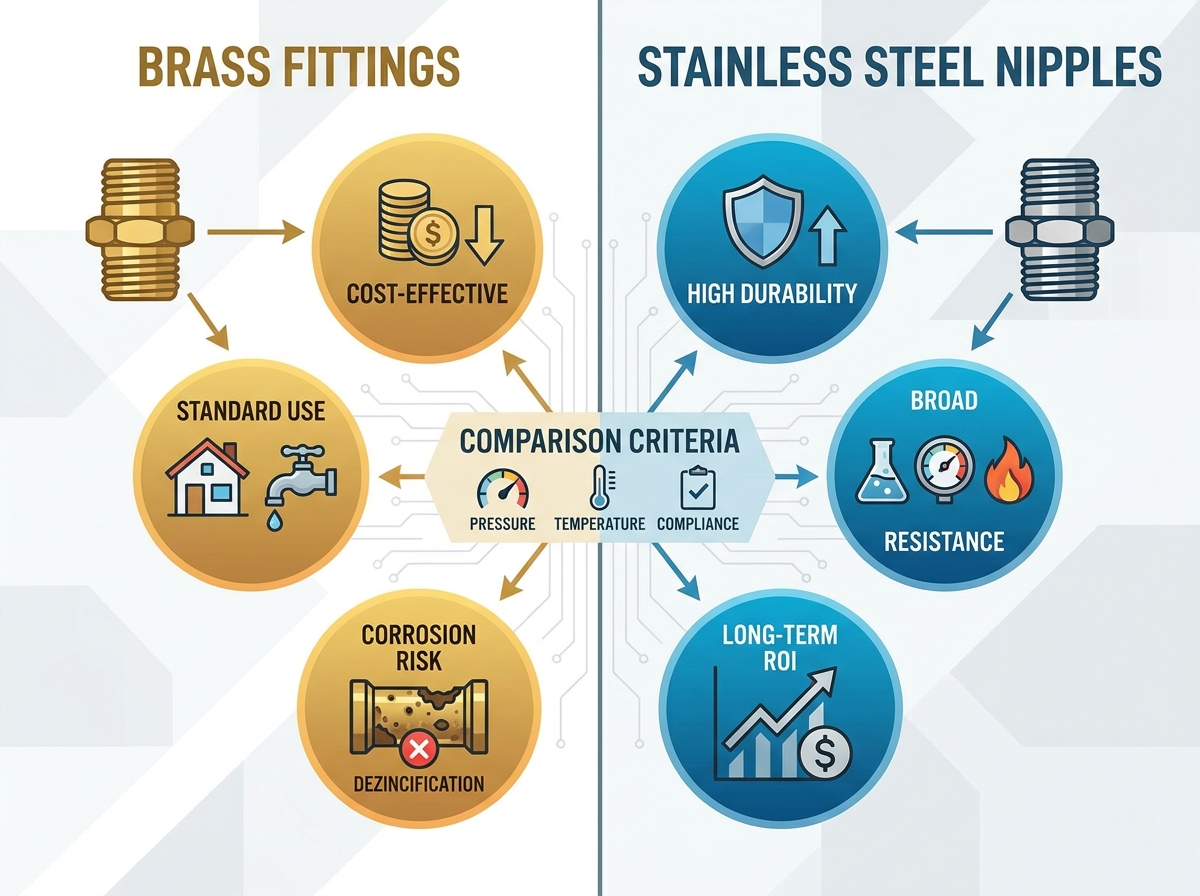
Heavy industrial operations require materials capable of surviving extreme physical punishment. Material science explains exactly why steel excels here. The alloy contains a high percentage of chromium. This chromium forms a passive, microscopic, self-healing oxide layer on the raw metal surface. This protective layer prevents deep rust and stops localized corrosion from spreading inward.
Alloy selection matters immensely when specifying new pipeline components. You must differentiate between standard material grades before finalizing your order. Basic 304/316 stainless steel pipe fittings serve distinctly different purposes in the field. Grade 304 is ideal for standard industrial use. It offers excellent durability for non-chloride environments. Grade 316 contains added molybdenum. This critical addition drastically improves resistance to microscopic pitting. You absolutely need 316 steel for high-chloride areas, coastal marine setups, or intense chemical processing plants.
Performance metrics further justify the material upgrade. Steel provides superior tensile strength. It easily withstands extreme temperature tolerances without losing structural shape. It routinely maintains perfect thread integrity under massive internal pressure loads. Robust industrial stainless pipe fittings are entirely non-negotiable in many rigorous sectors. Regulators mandate them across chemical processing, commercial food and beverage production, high-purity water filtration, and petrochemical refineries. These intense environments simply cannot tolerate the material fatigue associated with softer brass or plastic components.
Making the right material choice requires a direct comparison of physical properties. We can break this complex decision down into specific, measurable evaluation categories.
Chemical compatibility dictates how long a fitting survives in active service. Brass exhibits severe vulnerability to high chloride concentrations. It degrades incredibly fast when exposed to highly acidic or alkaline extremes. Conversely, high-grade steel boasts exceptionally broad chemical resistance. It easily handles aggressive cleaning chemicals, harsh process fluids, and demanding environmental washdowns without deteriorating.
Operational limits clearly separate these two competing materials. A softer brass alloy deforms permanently under excessive mechanical stress. Steel maintains perfect structural integrity at significantly higher PSI levels. It also survives massive temperature extremes without warping or losing vital thread engagement. When designing volatile steam systems or high-pressure hydraulics, steel remains the only safe, long-term option.
Modern fluid piping systems must adhere to strict hygiene and safety standards. The Safe Drinking Water Act and various FDA requirements strictly regulate all wetted component surfaces. Steel inherently meets these stringent global guidelines. It does not leach toxic heavy metals into the fluid stream. Using solid steel eliminates the deep compliance anxiety associated with trace lead contamination in aging brass systems.
Material Comparison Chart
Evaluation Criteria | Brass Fittings | Stainless Steel Fittings |
|---|---|---|
Corrosion Resistance | Moderate (highly vulnerable to dezincification) | Exceptional (protected by chromium oxide layer) |
Chemical Compatibility | Poor against strong industrial acids and chlorides | Excellent across most aggressive industrial fluids |
Temperature Limits | Lower operational threshold (prone to thermal deformation) | High extreme temperature and thermal shock tolerance |
Pressure Rating | Suitable for low-to-medium ambient PSI levels | Ideal for high-pressure heavy industrial loads |
Regulatory Compliance | Heavily restricted (ongoing lead content concerns) | Universally accepted (meets FDA and potable water rules) |
Replacing old piping components requires careful engineering oversight. We often face the difficult reality of retrofitting a new pipeline into much older infrastructure. Mixing materials introduces specific installation hazards.
The dissimilar metals problem frequently catches novice installers off guard. Connecting a new steel nipple directly to an existing brass or carbon steel line introduces major structural risks. Galvanic corrosion occurs whenever two different metals connect in the presence of an active electrolyte. Standard tap water acts as a perfect electrolyte. The less noble metal in the connection rapidly deteriorates. This electrochemical reaction causes unexpected, severe joint failure over a few short months.
You must employ specific mitigation strategies for mixed-metal connections. Use commercial dielectric unions to physically separate the incompatible alloys. Applying specialized, non-conductive thread sealants also helps isolate the metals. This simple step successfully breaks the electrical path. These evidence-based solutions prevent accelerated galvanic corrosion inside your aging piping network.
Preventing thread galling is another critical installation step. Galling, often called cold-welding, happens frequently during steel-to-steel connections. High friction tears the protective microscopic oxide layer. This friction causes the threads to fuse permanently. You can prevent this disaster by using proper lubrication techniques. Apply high-density PTFE tape directly alongside a premium nickel-based anti-seize compound. This specific combination lubricates the joint thoroughly. It ensures a leak-proof, fully removable seal for both NPT and BSPT thread types.
Sourcing high-quality system components requires rigorous vendor vetting. You must understand what separates basic commodity brokers from true enterprise-grade supply partners. A reliable stainless steel threaded nipple manufacturer provides absolute transparency, extreme machining precision, and verified material documentation.
Here is a strict checklist of capabilities you should demand from your chosen supplier:
Quality Assurance & Material Traceability: Always require official Mill Test Reports (MTRs) before purchasing any batch. These vital documents verify the exact chemical alloy composition. They ensure you do not accidentally install counterfeit or substandard 316 steel inside a critical chemical line.
Precision and Standards: Partner exclusively with a certified EN10241 nipple supplier. This global certification guarantees standardized uniform wall thickness. It ensures highly accurate thread geometry and highly reliable pressure ratings across every single batch produced.
Thread Competency: Machined thread quality dictates your final seal integrity. Evaluating a reliable BSPT threaded fittings manufacturer requires closely looking at their CNC machining tolerances. Exceptional CNC precision guarantees a perfect mechanical seal without requiring excessive wrench torque.
Before committing to a massive facility order, take actionable next steps. Advise your purchasing team to request physical sample batches for immediate engineering inspection. Review their internal QA documentation thoroughly. Finally, assess their supply chain scalability. You must ensure they can easily meet your long-term project deadlines without sudden backorders.
Selecting the correct piping components determines the long-term operational success of your entire fluid transport system. Brass remains somewhat viable for low-impact, legacy residential water systems. However, modern industrial and commercial scalability heavily favors robust steel alloys. Upgrading to higher-grade metals prevents catastrophic blowout failures. It ensures strict regulatory compliance across all jurisdictions. Steel effortlessly withstands brutal operational conditions that destroy lesser alloys. Base your final purchasing decision on a rigorous assessment of your specific application environment and required lifecycle endurance, rather than just unit price alone. Take action today by consulting directly with an engineering specialist. Review your current piping schematics carefully. Identify potential thermal or pressure stress points. Request a technical quote for certified, high-grade fittings to secure your facility infrastructure permanently.
A: Yes, but you must actively manage galvanic corrosion risks. When an electrolyte like standard water flows through dissimilar metals, the softer brass will corrode significantly faster. You should install a dielectric union to physically separate them. Alternatively, applying high-quality thread sealants and dense PTFE tape helps create a protective barrier. However, tape is slightly less foolproof than using a dedicated dielectric union.
A: Grade 316 costs more because it contains added molybdenum. This specific addition drastically improves the metal's resistance to pitting and severe chloride corrosion. If your system handles harsh cleaning chemicals, coastal saltwater, or acidic processing fluids, 316 is absolutely worth the upfront upgrade. For basic indoor industrial water lines, standard 304 is usually perfectly sufficient.
A: Yes. Steel is highly notorious for thread galling. High friction causes the precise threads to cold-weld and fuse together permanently. You cannot assemble them completely dry. You must use a high-density PTFE tape wrapped correctly. Pair this tape with a specialized nickel-based anti-seize compound. This specific combination heavily lubricates the threads and ensures a leak-free, easily removable joint.
A: EN10241 is a highly specific European standard governing steel threaded pipe fittings. It dictates exact minimum requirements for dimensions, thread geometry, pressure testing, and allowable material grades. Choosing fittings meeting this exact standard guarantees you receive premium components. They will feature uniform wall thickness and reliable mechanical seals, unlike uncertified, cheap commodity fittings.


