


close
Choose Your Site
Global
Social Media
Views: 0 Author: Site Editor Publish Time: 2026-08-19 Origin: Site


Material selection for industrial piping directly dictates system uptime. It impacts maintenance overhead and safety compliance. Relying on default specifications often leads to premature failure. You also risk overspending on incompatible replacements. Brass, carbon steel, and aluminum certainly have their place. Advanced plastics handle specific niches well. However, aggressive fluids and high-pressure environments demand stricter tolerances. Minor leaks escalate into catastrophic plant shutdowns quickly. Engineers need reliable components. This guide provides an evidence-based comparison. We evaluate industrial stainless pipe fittings against alternative materials. We will help engineers and procurement teams make balanced decisions. You will learn how system requirements dictate material choice. We also cover grade selection and installation risks.
Application Dictates Material: Brass and aluminum suffice for low-pressure, non-corrosive air or water lines, but industrial stainless steel is required for high-pressure, chemical, or sanitary applications.
TCO Over Initial Price: Stainless steel carries a higher upfront cost than carbon steel but significantly reduces long-term replacement, coating, and labor costs in corrosive environments.
Grade Matters: Deciding on stainless steel is only step one; choosing between 304/316 stainless steel pipe fittings based on chloride exposure is critical to preventing pitting corrosion.
Supplier Compliance is Non-Negotiable: Component reliability hinges on precision threading and material traceability. Partnering with an established BSPT threaded fittings manufacturer ensures leak-free integration.
Every piping network requires a strict operational baseline. You cannot select materials blindly. Engineers must define success criteria before procuring components. These criteria prevent catastrophic system failures.
First, evaluate your Maximum Operating Pressure (MOP). High-pressure hydraulic lines exert immense stress on connection points. Standard materials deform under these loads. Second, assess extreme temperature ranges. Extreme heat degrades certain metals rapidly. Deep freezing causes brittleness. Finally, analyze fluid compatibility. Assess the pH levels of the transported media. Highly acidic or alkaline fluids destroy weak alloys.
Pressure Thresholds: Define normal operating pressure and unexpected surge pressure.
Thermal Cycling: Calculate thermal expansion rates across seasonal temperature shifts.
Chemical Makeup: Document the exact chemical composition of the transported fluid.
Misapplication carries severe business risks. Under-specifying materials guarantees fluid leaks. These leaks cause sudden plant downtime. They trigger hefty environmental fines. They also create hazardous safety conditions for operators. You must specify materials correctly to avoid these outcomes.
External environments also dictate material upgrades. Marine settings introduce heavy salt spray. Heavy industrial zones expose systems to airborne corrosives. Food processing facilities require harsh chemical washdown zones. Standard metals degrade rapidly in these conditions. Premium alloys become necessary to survive exterior degradation.
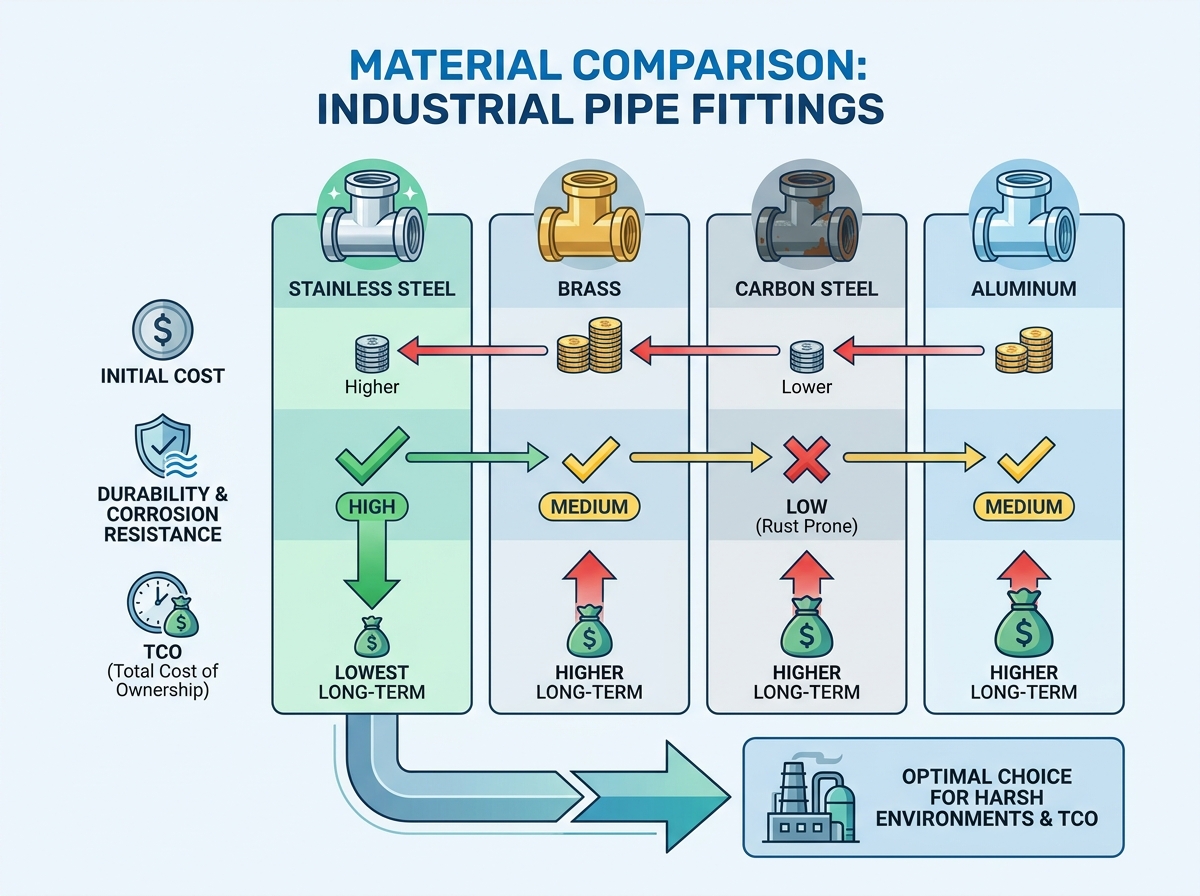
Facility managers often compare multiple alloys during procurement. We must examine the reality and limitations of each material. This comparison highlights why specific applications demand upgraded materials.
Brass offers excellent machinability. It provides a cost-effective solution for standard plumbing. Many facilities use it for basic pneumatic lines. It threads easily and seals well under light loads.
However, brass has severe limitations. It suffers from dezincification in highly acidic environments. The zinc leaches out of the alloy. This leaves behind a porous, fragile copper shell. Brass also possesses lower tensile strength. You must use stainless steel for aggressive chemicals. Higher pressure thresholds also mandate stronger alloys.
Carbon steel dominates heavy structural applications. It offers exceptional baseline strength. It also provides a lower initial purchase price. Heavy industrial setups rely heavily on carbon components.
The limitation lies in oxidation. Carbon steel rusts quickly when exposed to moisture. You must apply continuous protective coatings. You must galvanize or paint exterior surfaces frequently. Stainless steel eliminates this ongoing maintenance loop entirely. It forms its own passive oxide layer.
Aluminum remains incredibly lightweight. It dominates aerospace engineering. Specific automotive fluid transfers also rely on aluminum. It handles low-impact fluid transit efficiently.
Unfortunately, aluminum introduces galvanic corrosion risks. It degrades rapidly when paired with dissimilar metals. It also possesses lower temperature tolerance. It warps under extreme thermal stress. Stainless alloys offer superior structural rigidity. They withstand extreme mechanical impacts much better.
Material | Tensile Strength | Corrosion Resistance | Ideal Application |
|---|---|---|---|
Brass | Low to Medium | Poor (Dezincification risk) | Standard water, pneumatics |
Carbon Steel | High | Poor (Requires coating) | Structural piping, dry gasses |
Aluminum | Low | Medium (Galvanic risk) | Aerospace, lightweight transit |
Stainless Steel | Very High | Excellent (Self-passivating) | High-pressure, chemicals, marine |
Selecting the right alloy family is only the first step. You must specify the exact grade. The choice between grades dictates long-term survival. Using 304/316 stainless steel pipe fittings requires careful environmental analysis.
Grade 304 establishes the baseline for industrial performance. It contains 18% chromium and 8% nickel. It provides excellent oxidation resistance. It handles water, steam, and mild chemicals effortlessly. Most standard industrial applications rely on 304 components. They deliver reliable longevity in controlled indoor environments.
Grade 316 upgrades this formula. It incorporates 2% to 3% molybdenum. This specific addition transforms the alloy. Molybdenum drastically increases resistance to pitting corrosion. It protects the metal from chloride-heavy environments. Offshore oil rigs demand 316 components exclusively. Pharmaceutical processes also mandate this grade for sanitary integrity.
Engineers must use a decision matrix to avoid over-engineering. Specifying 316 components inflates procurement budgets. If your system transfers clean water indoors, 304 works perfectly. It meets all lifecycle requirements comfortably. Reserve 316 for environments exposing metal to salt, chlorine, or severe acids. This strategy controls costs effectively.
Upgrading your components does not guarantee invulnerability. Installation mistakes cause premature failures. You must understand implementation realities to protect your system.
Mixed-metal systems introduce galvanic corrosion risks. This happens when you connect dissimilar metals in an electrolyte. Carbon steel acts as an anode. Stainless alloys act as a cathode. The carbon steel will corrode rapidly. You must isolate your premium fittings from dissimilar metals. Use dielectric unions to break the electrical path. Apply specific non-conductive thread sealants during assembly. These best practices prevent hidden joint failures.
Installation teams also face galling risks. Galling refers to cold welding. Threaded stainless components generate immense friction during assembly. The threads tear and lock together permanently. You cannot disassemble a galled joint. Proper lubrication mitigates this risk entirely. Technicians must apply premium anti-seize compounds. High-density PTFE tape also reduces thread friction. You must train installers on these specific assembly techniques.
Finally, evaluate the full operational horizon. Look beyond the initial unit price. Factor in the expected lifespan of the system. Calculate the value of deferred maintenance. Consider the complete elimination of protective coating procedures over a twenty-year period. Durable components simplify facility management. They reduce labor hours spent on structural inspections.
Procuring reliable components requires strict vendor vetting. Global supply chains hide counterfeit materials. You must verify supplier capabilities before placing bulk orders.
Dimensional accuracy prevents pressure leaks. Thread cutting requires precise machinery. Even microscopic deviations compromise the seal. You need a verified BSPT threaded fittings manufacturer. They utilize advanced CNC equipment. They maintain strict quality control over thread angles and pitches.
Thread Precision: Ensures tight seals without excessive torque.
Wall Thickness: Prevents rupture under sudden pressure spikes.
Surface Finish: Reduces contamination risks in sanitary applications.
Material traceability remains non-negotiable. You must demand Material Test Reports (MTRs) for every batch. These documents verify the exact chemical composition. They confirm the chromium and nickel percentages. MTRs prevent you from installing low-grade imports. Counterfeit alloys fail under pressure and endanger personnel.
Standardization builds a strong business case. Consolidating procurement improves maintenance efficiency. Partner with an authoritative EN10241 nipple supplier. They guarantee batch-to-batch consistency. They ship identical parts to your global facilities. Alternatively, utilize a dedicated stainless steel threaded nipple manufacturer. Direct manufacturer relationships streamline technical support.
Take concrete next steps. Initiate a technical review of your current schematics. Request a pilot batch for testing. Install these components in a system-critical upgrade. Monitor their performance before rolling out facility-wide replacements.
Material selection defines the safety of your facility. Alternatives like brass or aluminum win on niche weight metrics. Carbon steel offers a lower initial purchase price. However, stainless steel remains the definitive choice. It provides unmatched durability and chemical resistance. It survives environments where other metals disintegrate rapidly.
Procurement and engineering teams should act immediately. Review your current system failure rates. Identify joints requiring frequent maintenance. Consult a technical specialist to audit your fitting specifications. Upgrading your vulnerable connection points secures your operational baseline. Prioritize precision, traceability, and material compatibility.
A: Yes, but you must manage galvanic corrosion risks. When dissimilar metals connect in an electrolyte, the less noble metal corrodes rapidly. You must isolate them. Use dielectric unions to break the electrical connection. Apply non-conductive thread sealants. These methods protect the weaker metal from accelerated degradation.
A: Standard threaded fittings handle moderate industrial pressures safely. However, extreme high-pressure hydraulics require dedicated hydraulic components. You must verify pressure ratings and wall thickness. Standard threaded connections may fail under severe hydraulic spikes. Always consult the manufacturer's pressure chart before applying them to hydraulic lines.
A: NPT and BSPT use different thread angles and pitches. NPT features a 60-degree angle. BSPT uses a 55-degree angle. They do not mate correctly. Forcing them together causes cross-threading and catastrophic leaks. You must match your system standards. Always source from a specialized manufacturer to ensure dimensional accuracy.


