


close
Choose Your Site
Global
Social Media
Views: 0 Author: Site Editor Publish Time: 2026-08-21 Origin: Site


Pipe failures, sudden leaks, and unexpected system downtime share a common origin. They often trace back to improper fitting selection or mismatched threading. Upfront costs for stainless steel components are certainly higher than carbon steel or brass equivalents. However, their superior long-term performance in corrosive or high-pressure environments easily justifies this investment. Facilities simply cannot afford premature material degradation. This guide provides a purely technical, evidence-based framework. You will learn how to accurately evaluate, specify, and source the correct components. We designed this resource to help you ensure system longevity. You will also understand how to maintain strict regulatory compliance across various demanding industrial sectors. Let us dive directly into the critical specifications you need to make informed, resilient piping decisions.
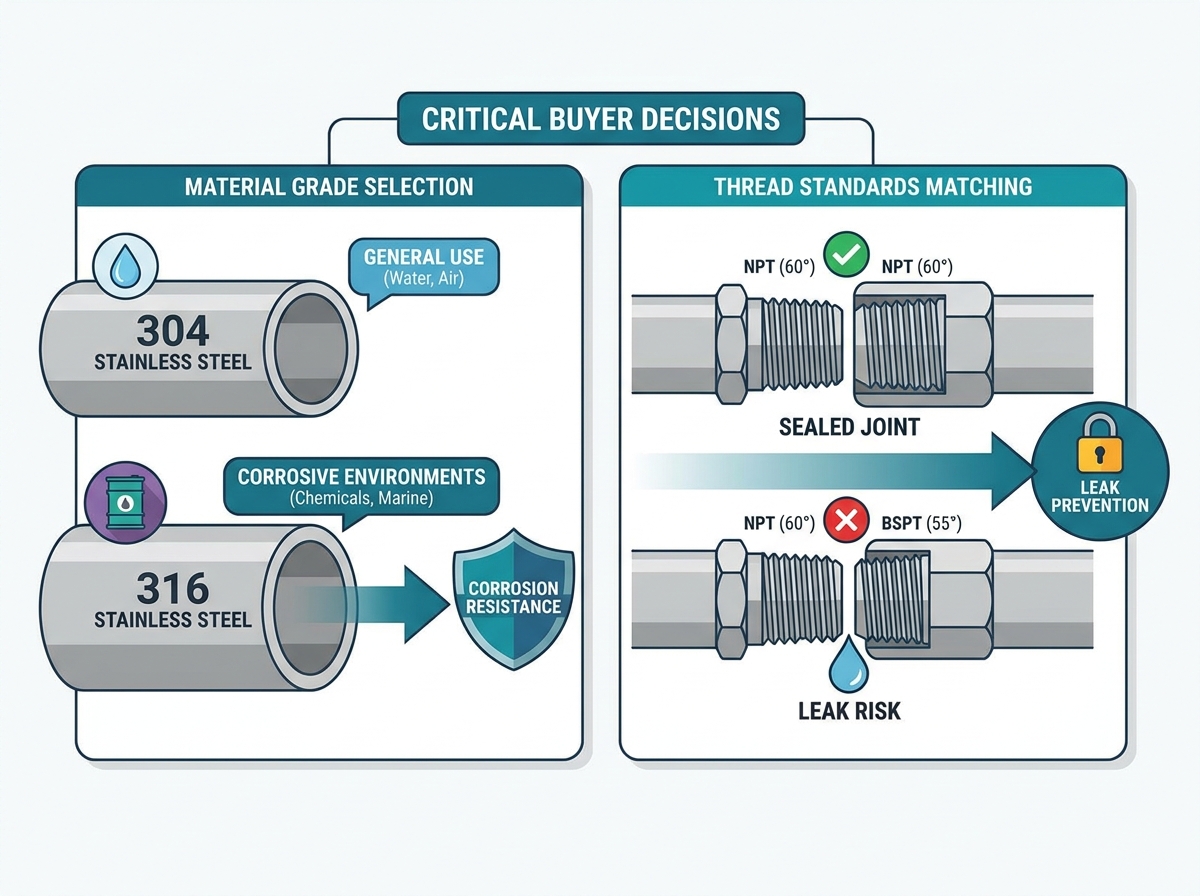
Material Grade is Non-Negotiable: The choice between 304 and 316 stainless steel dictates corrosion resistance, especially in chloride-rich or marine environments.
Thread Standards Must Match: Mixing NPT and BSPT threads guarantees leaks. Verification of threading standards is the first step in procurement.
Installation Requires Specific Protocols: Stainless steel is highly susceptible to thread galling (cold welding); proper lubrication and torque protocols are mandatory.
Traceability Matters: A reliable supplier must provide Mill Test Reports (MTRs) to verify alloy composition and structural integrity.
Selecting the right alloy dictates the lifespan of your piping system. Engineers primarily choose between two dominant austenitic grades. You must understand their distinct chemical compositions to avoid catastrophic field failures. We will examine the baseline standard first.
The 304 stainless steel grade forms the baseline for many industries. You will see it frequently utilized in general water, air, and non-corrosive chemical applications. It offers excellent baseline tensile strength. It also provides strong general oxidation resistance. However, it carries very specific limitations. It remains highly susceptible to localized pitting corrosion. This degradation happens rapidly in environments containing high chloride or salt exposure. You should never use it for seawater cooling lines.
The 316 stainless steel grade represents a mandatory upgrade for harsh conditions. You must specify it for industrial processing, marine environments, and aggressive chemical handling. Why does it perform so much better? It contains a crucial alloying element called molybdenum. This specific addition actively prevents chloride-induced pitting. You secure far better longevity in coastal facilities. Many engineers refer to its Pitting Resistance Equivalent Number (PREN) to validate this superior performance. When you source 304/316 stainless steel pipe fittings, you must match the grade exactly to your environmental exposure.
When comparing brass to stainless steel, the evaluation lens shifts significantly. Stainless eliminates dezincification risks entirely. Brass components often lose their zinc content over time in aggressive water. This leaves behind a weak, porous copper shell. Stainless also delivers significantly higher tensile strength under mechanical stress. You must avoid mixing brass and stainless directly in closed-loop fluid systems. Doing so without proper dielectric isolation triggers severe galvanic corrosion. The less noble metal will sacrifice itself and disintegrate rapidly.
Material Grade | Primary Alloying Elements | Best Application Environment | Notable Vulnerability |
|---|---|---|---|
304 Stainless Steel | 18% Chromium, 8% Nickel | General air, potable water, mild chemicals | Chloride-induced pitting (saltwater) |
316 Stainless Steel | 16% Chromium, 10% Nickel, 2% Molybdenum | Marine, petrochemical, highly corrosive fluids | Higher initial material expenditure |
Brass | Copper, Zinc | Low-pressure residential plumbing | Dezincification, galvanic corrosion risks |
Pipe dimensions extend far beyond simple diameter measurements. Wall thickness directly dictates pressure capacity and mechanical resilience. We measure this thickness using standardized pipe schedules. Schedule 40 serves standard commercial applications perfectly. It handles moderate pressure demands with ease. Schedule 80 steps up the thickness considerably. You absolutely need this thicker profile for high-pressure industrial systems. These robust walls safely absorb intense mechanical stress and vibration.
Next, you must decode complex thread standards. National Pipe Thread (NPT) dominates North American installations. It features a precise 60-degree thread angle with flattened peaks and valleys. Conversely, British Standard Pipe Taper (BSPT) dominates overseas markets. You will find it widely used across Europe and Asia. It utilizes a slightly different 55-degree thread angle with rounded peaks. Working with a reliable BSPT threaded fittings manufacturer ensures dimensional accuracy for international projects.
This geographic difference creates a severe implementation risk. You might accidentally try forcing a BSPT component into an NPT receptacle. Doing this destroys the precision threads instantly. The joint will permanently fail to seal, causing dangerous industrial leaks. Thread sealants cannot fix mismatched geometries.
How do you measure these components accurately? Nominal Pipe Size (NPS) confuses many technicians in the field. NPS does not equal the actual outside diameter (OD). You must follow strict measurement protocols to prevent costly procurement errors.
Clean the pipe threads thoroughly using a wire brush to remove old debris.
Use calibrated digital calipers to measure the exact outside diameter at the widest point.
Compare your exact OD measurement against a standardized NPS conversion chart.
Never assume a one-inch OD translates to a one-inch nominal pipe size.
Count the threads per inch (TPI) using a standardized thread pitch gauge.
Different industrial sectors demand vastly unique material specifications. You cannot treat pipe components as universal commodity hardware. Consider the food, beverage, and pharmaceutical manufacturing sectors. They require exceptionally high surface finishes. We call these components sanitary fittings. They actively prevent bacterial growth hiding inside microscopic metal crevices. Facilities often avoid threaded joints entirely in these environments. They favor seamless tri-clamp connections to allow rapid, sterile cleaning procedures.
Petrochemical processing and oil refineries face entirely different realities. They require seamless tubular components rather than welded ones. A premium seamless industrial stainless pipe fittings setup handles extreme pressure ratings. It also survives violent temperature fluctuations without structural fatigue. Welded seams often become weak points under intense thermal cycling.
Regulatory compliance guarantees workplace safety. You must rigorously evaluate parts based on standardized dimensions. For example, the ASME B1.20.1 standard governs precise thread geometries in North America. Furthermore, sourcing from a verified EN10241 nipple supplier makes a monumental difference for European installations. It ensures your components meet strict continental standards. These standards heavily govern thread precision, minimum wall dimensions, and rigorous hydrostatic testing protocols.
You must always verify these specifications before finalizing purchase orders. Request documentation showing compliance with ASTM A733 or similar relevant codes. This proactive verification eliminates compliance failures during mandatory facility inspections.
Thread galling poses a massive risk during installation. Industry veterans often call this phenomenon cold welding. Stainless steel inherently possesses a highly protective chromium oxide surface layer. It generates extremely high friction during mechanical tightening. The protective oxide layer aggressively scrapes off under this pressure. Bare metals touch directly and microscopic tearing occurs instantly. The threads weld together permanently. This locks the joint completely tight before it even seals.
Once galling occurs, you cannot reverse it. You must cut the Stainless Steel Nipple out of the system entirely. This causes severe project delays and material waste. You can prevent this effectively by using strict installation protocols. Let us examine the proven best practices.
Never assemble stainless steel threads dry under any circumstances.
Apply a premium, nickel-based anti-seize compound thoroughly across the male threads.
Wrap high-density Teflon (PTFE) tape strictly in the rotational direction of the threads.
Combine the PTFE tape with a chemically compatible liquid pipe dope for maximum lubrication.
Apply slow, consistent mechanical torque manually during the entire installation process.
Avoid high-speed pneumatic power tools completely because they multiply friction rapidly.
Common mistakes include over-tightening small diameter pipes. Technicians often apply excessive leverage using large pipe wrenches. This distorts the thread geometry and encourages immediate galling. You should only tighten the fitting enough to achieve a leak-free seal. Test the system hydrostatically to confirm joint integrity before full operational handover.
Evaluating vendors goes far beyond comparing basic unit prices. You should aggressively look for manufacturers who control their entire metallurgical supply chain. A premier stainless steel threaded nipple manufacturer removes the guesswork from procurement. They offer consistent quality control across decades of production.
Material traceability stands as a crucial evaluation dimension. Do they provide comprehensive Mill Test Reports (MTRs)? You absolutely need these documents for every single production batch. They verify exact chemical compositions, including the critical molybdenum content in 316 alloys. They also display precise heat numbers and mechanical yield strengths.
Machining precision matters just as much as chemical makeup. Are the threads cleanly cut on the factory floor? Do you see minimal metal burrs upon visual inspection? Poor factory machining causes the vast majority of unpredictable field leaks. You cannot fix bad manufacturing with extra pipe tape.
Inventory depth heavily impacts your project timelines. Can the chosen supplier provide a full ecosystem of parts? You need elbows, tees, and straight pipes in identical grades. Procuring everything from one source prevents mismatched alloys inside a single pipeline network. This unified approach eliminates unexpected galvanic corrosion hotspots.
Always demand physical sample parts first. Perform destructive testing on them in your own facility. Verify their dimensions using certified ring and plug thread gauges. Complete this rigorous quality assurance process before committing to bulk industrial procurement contracts.
Specifying piping components requires careful alignment of material grades with actual environmental realities. You must match thread geometries perfectly to prevent catastrophic joint failures. Enforce strict manual installation protocols to eliminate cold welding risks across your entire workforce. Treat these specialized components as critical facility infrastructure rather than disposable commodity hardware. Doing so dramatically reduces long-term maintenance expenses and unexpected system downtime. We strongly recommend consulting directly with an engineering-focused manufacturer to finalize your technical specification sheet before ordering.
A: Measure the end-to-end length including the threads. Note the exact Outside Diameter (OD) using precise digital calipers. You must then use standard NPS charts to convert this OD to the correct nominal size. Remember, a one-inch nominal pipe does not have an exactly one-inch outside diameter.
A: It depends entirely on the specific installation history. If the threads experienced any minor galling or mechanical deformation during the initial tightening, reusing it guarantees future leaks. You must always inspect the thread peaks meticulously with a magnifying tool before attempting any reuse.
A: It is generally not recommended without installing a proper dielectric union. The two dissimilar metals accelerate galvanic corrosion rapidly. This electrochemical reaction causes the softer galvanized carbon steel pipe to degrade and rust heavily at the connection point.


