


close
Choose Your Site
Global
Social Media
Views: 0 Author: Site Editor Publish Time: 2026-08-20 Origin: Site


Industrial piping systems regularly suffer from hidden inefficiencies. Pipeline failures, fluid leaks, and unexpected downtime often stem from specifying incorrect or sub-standard pipe fittings. When a single joint fails, it can shut down an entire chemical processing line or halt a manufacturing floor, leading to massive financial losses. We must view the fitting not just as a commodity component, but as a critical connection point. It strictly dictates the pressure integrity and corrosion resistance of the entire piping system. Small mistakes in specification carry massive operational risks for engineers and project managers alike. This article provides engineering and procurement teams with a definitive framework for evaluating material grades, thread standards, and supplier credibility. You will learn how to balance alloy chemistry against environmental factors and accurately interpret schedule ratings. Applying these principles ensures safe, durable, and highly cost-effective procurement strategies for your infrastructure.
Material selection dictates lifespan: Choosing between 304 and 316 grades depends strictly on chloride exposure and localized corrosion risks.
Thread standards are not interchangeable: Mixing NPT and BSPT threads leads to guaranteed system leakage and thread damage.
Wall thickness equals pressure threshold: Understanding pipe schedules (e.g., Sch 40 vs. Sch 80) is mandatory for high-temperature and high-pressure industrial environments.
Supplier vetting requires documentation: Reliable procurement relies on verifiable Mill Test Reports (MTRs) and strict adherence to manufacturing standards like EN10241.
Both 304 and 316 alloys offer excellent baseline oxidation resistance. They share a core foundation of chromium and nickel, which creates a passive oxide layer on the metal's surface. However, their chemical compositions serve distinctly different operational environments. You cannot treat them as universally interchangeable without risking catastrophic material degradation over time. Facility managers must carefully analyze the fluid medium and ambient environment before making a final purchasing decision.
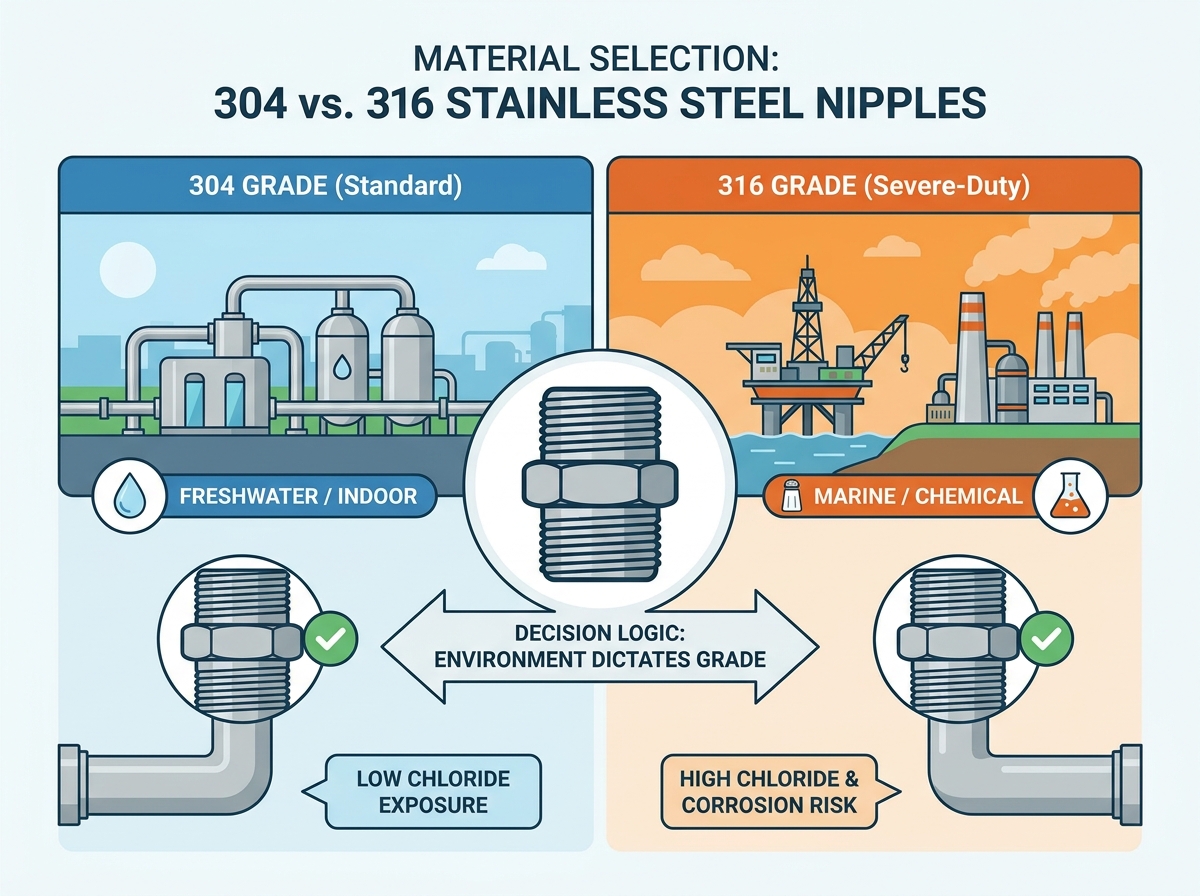
Grade 304 remains the cost-effective standard across countless industries. It excels in freshwater applications, standard atmospheric conditions, and neutral chemical processing facilities. We frequently see it perform flawlessly in food and beverage pipelines or indoor utility routing. Procuring 304/316 stainless steel pipe fittings correctly starts with recognizing where the 304 alloy reaches its limits. It is highly susceptible to localized pitting in high-chloride environments. You should strictly avoid deploying 304 near coastal facilities, offshore platforms, or areas subjected to heavy de-icing salt exposure. In these settings, the chlorides quickly penetrate the protective oxide layer, leading to rapid, unseen structural decay.
Grade 316 represents the necessary severe-duty upgrade. The crucial difference lies in its chemical makeup. Grade 316 contains two to three percent molybdenum. This addition dramatically increases the alloy's resistance to chloride-induced pitting and destructive crevice corrosion. Yes, it carries a higher upfront material cost. Yet, you absolutely need it for marine environments, rigorous pharmaceutical manufacturing, and aggressive chemical applications to prevent premature system failure. The return on investment becomes obvious when you factor in the labor and downtime costs of replacing failed lines.
Use clear decision logic to optimize your project budgets. Avoid over-specifying 316 if your fluid medium and external environment simply do not demand it. If you route treated municipal water through a climate-controlled facility, Grade 304 will easily outlast the surrounding equipment. Strategic material selection balances upfront capital expenditure against long-term maintenance realities.
Material Grade | Key Alloy Composition | Ideal Operational Environments | Primary Structural Limitation |
|---|---|---|---|
Grade 304 | 18% Chromium, 8% Nickel | Freshwater, neutral chemicals, indoor utility lines, food processing | Highly vulnerable to chloride-induced pitting and crevice corrosion |
Grade 316 | 16% Chromium, 10% Nickel, 2% Molybdenum | Marine, pharma, harsh chlorides, acidic processing, offshore setups | Higher initial procurement cost compared to standard grades |
The compatibility mandate in pipeline construction is unforgiving. Thread mismatch remains the single leading cause of joint failure in industrial piping networks. You cannot force different thread profiles together without permanently compromising the system's integrity. When workers force mismatched threads, they strip the metal and create invisible micro-channels where high-pressure fluids easily escape.
NPT (National Pipe Thread) features a specific tapered design. It represents the primary interference fit standard utilized across North America. The taper allows the male and female threads to wedge tightly together as you apply torque. However, metal-to-metal contact alone does not create a complete seal. You must use appropriate thread sealants to fill the microscopic voids between the thread crests and roots. Installers commonly use high-density PTFE tape or specialized liquid pipe dope to achieve a genuinely leak-proof seal under pressure.
BSPT and BSPP (British Standard Pipe) operate on different geometric principles. BSPT uses a tapered profile similar to NPT, but it features a different thread angle (55 degrees instead of 60 degrees). BSPP relies on a straight, parallel structure requiring a bonded seal ring or washer to prevent leaks. You must never mix NPT and BSPT components. While they might thread together for the first few turns, they will eventually bind and leak. When retrofitting European or Asian equipment, you need exact dimensional matches. Partnering with a specialized BSPT threaded fittings manufacturer guarantees correct pitch configurations and prevents devastating leaks on the factory floor.
We classify nipple lengths into Close, Short, and Long categories to accommodate different structural needs.
Close Nipples: Feature continuous threading from end to end with no unthreaded center block. They sit almost entirely inside the mating female fittings.
Short Nipples: Provide a very small bare middle section, allowing just enough room for basic wrench engagement.
Long Nipples: Offer an extended unthreaded shank, customized to span specific gaps between machinery.
Your choice strictly depends on spatial constraints and wrench-clearance requirements during installation. Always measure the total make-up length required before ordering.
Your system's wall thickness directly determines its maximum pressure threshold. We measure this critical thickness using standard pipe schedules. You must understand the practical operational difference between Schedule 40 (Standard) and Schedule 80 (Extra Heavy). Schedule 80 features a significantly thicker internal wall, which slightly reduces the internal flow diameter but vastly increases structural strength. Frame your choice based on internal fluid pressure, external mechanical stress, and the necessary corrosion allowance over decades of use. You must rigorously vet industrial stainless pipe fittings against these specific engineering metrics. If abrasive slurries flow through the line, the thicker walls of Schedule 80 provide a longer lifespan before erosion causes a breach.
Temperature derating introduces another unavoidable physical reality into piping design. As operating temperatures increase, the maximum allowable working pressure (MAWP) of the metal actively decreases. Extreme heat fundamentally weakens the molecular structure of steel. A fitting rated for 2,000 PSI at room temperature might only safely hold 1,200 PSI at 400 degrees Fahrenheit. You must reference ASME B31.3 standards as your authoritative lens. These industry codes provide exact mathematical formulas for calculating high-temperature and high-pressure safety margins. Neglecting to derate your fittings guarantees an eventual blowout.
Ignore these variables, and you invite severe implementation risks into your facility. Using standard-weight nipples in high-vibration environments frequently leads to rapid mechanical failure. For example, connecting a standard Schedule 40 piece directly to an industrial pump discharge introduces severe kinetic stress. The continuous vibration causes fatigue cracking right at the deepest part of the thread root. Always specify thicker schedules and incorporate vibration dampening strategies to combat this kinetic stress effectively.
Thread galling, frequently called cold welding, presents the single biggest installation risk for stainless steel hardware. When you thread two identical stainless alloys together under high torque, extreme friction destroys the microscopic protective oxide layer. The bare metals essentially fuse together on a molecular level. Once galling occurs, you cannot reverse it. You must cut the fitting out of the system. You must enforce strict installation protocols to combat this phenomenon. The mandatory use of nickel-based or specialized anti-seize lubricants stops galling before it starts. Additionally, instruct your teams to use slow installation speeds, as power tools generate too much heat and instantly trigger galling.
Galvanic corrosion creates another insidious, hidden danger within mixed-metal systems. Never thread a Stainless Steel Nipple directly into carbon steel, galvanized iron, or dissimilar metal components. If your environment remains highly humid or involves conductive fluids, this direct contact destroys the less noble metal. The carbon steel acts as an anode and rusts at an accelerated rate, eventually shearing off entirely. Always use dielectric unions or proper isolation flanges to break the electrical conductivity path between mismatched metals.
System cleanliness demands equal attention before any system goes live. Poor preparation damages sensitive downstream equipment.
Always deburr threads thoroughly after any custom cutting or modifications.
Clean the joint meticulously to remove residual cutting oils or manufacturing dust.
Blow out all metal shavings using industrial compressed air before final assembly.
Skipping these essential steps allows hard debris to enter the fluid stream. These metal shards will easily destroy sensitive flow meters, jam precision control valves, and contaminate high-purity chemical batches.
Reliable supply chains demand total transparency and rigorous quality assurance. A credible supplier must readily provide Mill Test Reports (MTRs) for every single batch you purchase. These certified documents detail the exact chemical composition, heat lot number, and physical yield properties of the steel. Without an authentic MTR, you cannot verify the alloy's true grade. A missing document often indicates inferior, non-compliant steel that will fail under pressure.
International sourcing requires strict adherence to documented manufacturing standards. You must verify if your chosen EN10241 nipple supplier adheres strictly to dimensional tolerances. They should follow criteria outlined by ISO, DIN, or ASTM/ASME without deviation. Evaluating a stainless steel threaded nipple manufacturer requires a close look at their machining quality. We recommend conducting a visual inspection on sample batches before signing large contracts. Examine the thread finish for supreme smoothness. You should immediately reject any parts showing metal tears, rough chatters, or inconsistent depths. Proper 45-degree chamfering on the thread edges remains non-negotiable, as it directly impacts initial alignment and sealing capability.
Apply logical shortlisting criteria to build lasting vendor relationships. Do not evaluate partners solely on the lowest unit price. You must also consider their ongoing inventory availability and automated CNC precision consistency. A vendor offering massive discounts often utilizes manual lathing, resulting in inconsistent thread pitches across a large order. Their ability to handle custom lengths, rapid turnaround times, or exotic alloys for scale often separates true manufacturing partners from basic commodities brokers. A robust vendor acts as an extension of your engineering team, ensuring every component meets baseline safety standards.
Specifying the right connections requires a highly balanced approach. You must carefully weigh the material grade, thread standard, and schedule thickness against the specific physical realities of your industrial environment. A misstep in schedule selection or an oversight in thread matching guarantees dangerous leaks and expensive downtime. We encourage buyers to actively audit their current piping specifications to identify weak points. Request MTR samples from your prospective manufacturers immediately to establish a baseline of trust. If you operate high-pressure, corrosive, or high-temperature lines, contact specialized application engineers to comprehensively review your system designs before beginning procurement. Proper diligence today prevents catastrophic pipeline failures tomorrow.
A: We strongly advise against reusing them for critical pressure systems. Installing tapered threads deforms the metal slightly to create a mechanical seal. Reusing previously torqued threads severely compromises this seal, increasing the risk of fluid leaks and thread galling.
A: Close nipples feature threads over their entire length, leaving no unthreaded area. Hex nipples include a central hexagonal section. This central block provides a secure grip for wrenches, offering significantly easier installation and removal during maintenance.
A: This happens due to thread galling, or cold welding. Friction between identical stainless alloys destroys the surface oxide layer, causing the metals to fuse. You can prevent this by installing fittings slowly and applying specialized anti-seize lubricants.
A: You should cross-reference the heat number stamped on the fitting with the provided Mill Test Reports (MTRs). For critical applications, perform Positive Material Identification (PMI) testing using an XRF analyzer to confirm the exact chemical composition.


