


close
Choose Your Site
Global
Social Media
Views: 0 Author: Site Editor Publish Time: 2026-10-01 Origin: Site


Every contractor knows a tiny leak can destroy a massive project. Specifying the wrong components often leads to failed inspections. Expensive callbacks and severely compromised project margins usually follow. You must move beyond basic residential advice to focus on commercial liability. Navigating strict code compliance requires a sharp technical eye. Evaluating complex labor-efficiency tradeoffs is equally critical for modern contractors. Relying on substandard materials exposes your entire business to unacceptable risks and reputational damage.
This guide provides a rigorous technical and commercial evaluation framework. We will show you how to confidently source and shortlist industrial and residential components. You will learn to navigate complex supplier catalogs efficiently. We will help you match specific materials to highly demanding applications. By mastering these procurement strategies, you protect your bids. Ultimately, you will secure faster sign-offs on your next major commercial installation.
Code compliance (ASTM/ASME standards) and material compatibility are the non-negotiable baselines for commercial plumbing procurement.
Evaluating connection methods (e.g., press vs. sweat) requires balancing upfront component costs against skilled labor time and job-site safety constraints.
Mixing metals without proper dielectric transitions remains a leading cause of premature system failure via galvanic corrosion.
Standardizing supplier certifications mitigates supply chain risks and counterfeit liabilities on large-scale HVAC or plumbing rollouts.
Contractors often face overwhelming choices in supplier catalogs. You need a systematic way to narrow down these options. The best approach defines absolute project constraints before ever looking at price tags. High-quality plumbing pipe fittings must survive harsh environments. Failing to set strict baseline parameters invites catastrophic system failures.
Pressure and temperature ratings form the foundation of any specification. You must define the maximum operating thresholds clearly. Buyers frequently confuse sustained working pressure with surge tolerance. Sustained pressure is the constant force the system handles daily. Surge tolerance accommodates sudden spikes caused by water hammer. Specifying components based only on average pressure is a dangerous mistake.
Next, you must evaluate media and corrosion resistance. The fluid type running through the system dictates your material choices. Consider these common commercial scenarios:
Potable water requires strict health and safety approvals.
HVAC chilled water demands high resistance to internal scaling.
Aggressive chemicals require highly specialized, non-reactive plastics.
Environmental exposure also plays a massive role. Underground installations face soil acidity and moisture. Exposed rooftop systems must endure constant UV degradation.
Finally, code and regulatory compliance guarantee inspection passes. You must ensure all components meet localized plumbing codes. For potable water, NSF/ANSI 61 certification is an absolute legal requirement. Passing commercial building inspections depends entirely on verifiable regulatory compliance.
Selecting the right material prevents early degradation and costly replacements. Copper remains a gold standard for specific commercial jobs. Both standard and press copper components offer unmatched reliability. They also provide natural antimicrobial properties. You should always ensure adherence to Copper Development Association (CDA) standards. Copper performs exceptionally well for potable water and commercial HVAC networks.
Plastics present a completely different set of advantages. PVC, CPVC, and PEX contrast sharply in material costs and flexibility. PVC is highly cost-effective but has strict temperature limitations. It degrades quickly when carrying hot water. CPVC safely handles much higher temperatures up to 200 degrees Fahrenheit. Meanwhile, PEX manifolds offer massive labor advantages. They easily bend around structural obstacles, reducing the need for multiple joints.
Galvanized and black malleable iron serve heavier industrial needs. Black iron is the traditional choice for commercial gas lines. Galvanized steel works well for high-stress industrial chilled water lines. However, you must note the long-term internal scaling risks associated with galvanized materials. Over decades, mineral deposits severely restrict water flow.
Risk mitigation is crucial when transitioning between different materials. You cannot simply thread a copper pipe directly into galvanized steel. Mixing dissimilar metals causes rapid galvanic corrosion. You must specify dielectric unions for these transitions. Dielectric unions physically separate the metals using a plastic or rubber washer. This simple step prevents electrical currents from destroying the joint.
Table: Common Material Applications and Limitations
Material Type | Best Application | Key Limitation | Required Certification |
|---|---|---|---|
Copper | Potable water, HVAC | High upfront commodity cost | CDA, NSF 61 |
PVC | Cold water, drainage | Strict high-temperature limits | ASTM D1785 |
CPVC | Hot water distribution | Becomes brittle over time | ASTM F441 |
Black Iron | Natural gas, steam | Highly susceptible to rust | ASTM A53 |
Understanding sizing metrics is historically confusing for new procurement teams. You must clarify the critical differences between measurement standards. Nominal Pipe Size (NPS) does not directly match the physical dimensions. Outer Diameter (OD) and Inner Diameter (ID) vary wildly across different materials. For example, a 2-inch copper tube has a different OD than a 2-inch PVC pipe. You cannot interchange them without specific adapter components.
Deciphering supplier spec sheets is a vital buyer skill. You need a reliable process to evaluate technical data sheets. Follow these steps when reviewing a new component specification:
Verify the Schedule: Check the wall thickness schedule immediately. Schedule 40 is standard, while Schedule 80 provides thicker walls for higher pressure.
Confirm the Alloy Grade: Ensure the specific metal alloy matches your corrosion resistance requirements.
Check the Thread Standard: Differentiate between NPT (National Pipe Thread) and straight threads to ensure a leak-proof seal.
Locate the Temperature Curve: Review the pressure de-rating curve. Pressure capacity drops significantly as system temperature rises.
Evaluating manufacturing tolerances separates premium brands from cheap alternatives. You must emphasize tight manufacturing tolerances during procurement. High-pressure applications will violently exploit microscopic gaps. Loose tolerances lead to threaded joints weeping under load. Strict adherence to ASTM and ASME dimensional standards prevents these disastrous joint failures.
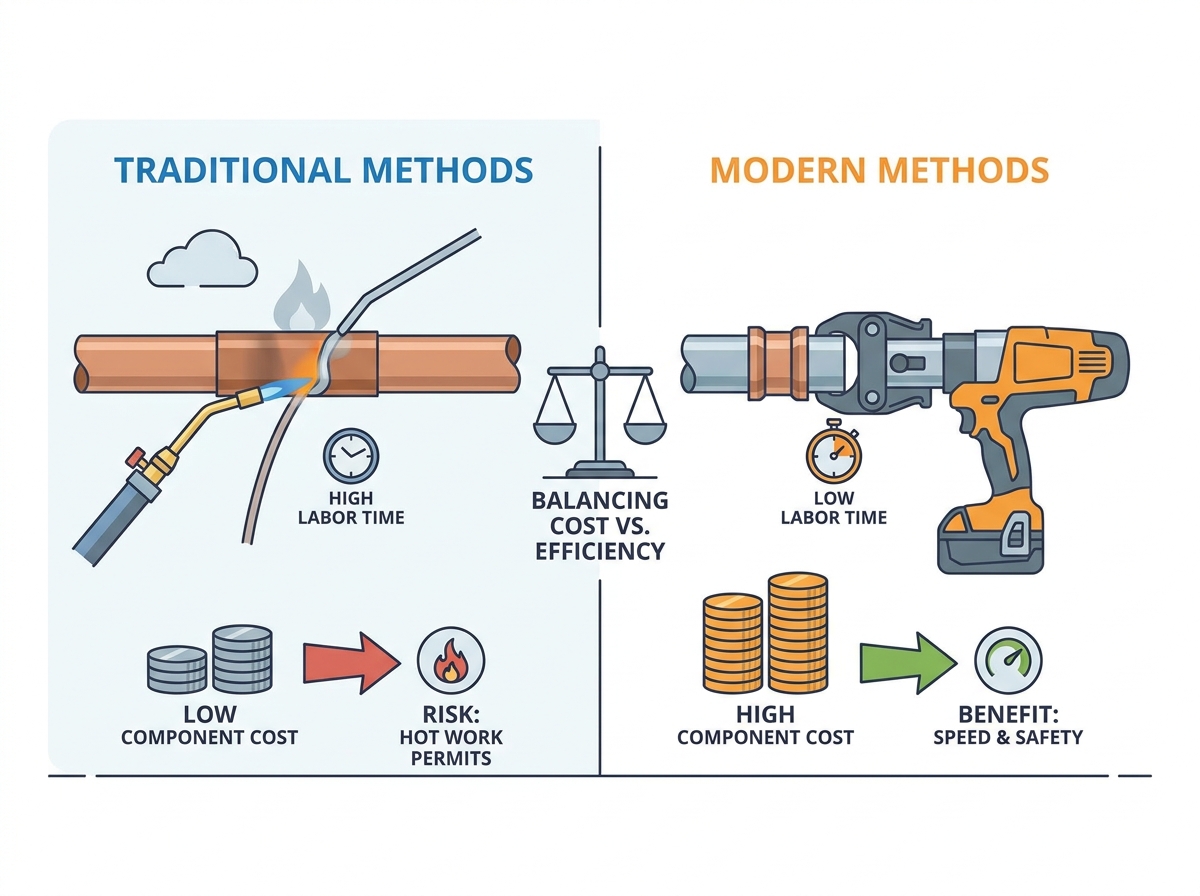
Choosing a connection method drastically impacts your project timeline and margins. Threaded and soldered joints represent the traditional industry standards. They offer high reliability and remarkably low component costs. However, sweat joints require highly skilled labor. They also demand hot-work permits and dedicated fire watches. These administrative burdens slow down fast-paced commercial job sites.
Press and push-to-connect systems serve as modern labor-saving alternatives. You must evaluate them through a strict commercial lens. They carry a significantly higher upfront cost per piece. Pressing also requires expensive, specialized crimping tooling. However, you weigh this against drastically reduced installation time. A press joint takes seconds to secure. This efficiency easily offsets the initial hardware investment on large projects.
Risk consideration is still necessary for modern methods. Push-to-connect components sometimes raise liability and warranty concerns. Many contractors hesitate to bury them behind closed drywall. You must review the manufacturer's warranty regarding concealed installations. Always ensure your localized building code permits their use in inaccessible locations.
Flanged and grooved connections dominate heavy industrial environments. They offer excellent commercial scalability for massive networks. Grooved systems, like those pioneered by Victaulic, allow for rapid assembly of large-diameter pipes. They also provide superior maintenance accessibility. Facility managers can easily unbolt a single flanged section for retrofitting. This modularity makes them ideal for commercial boiler rooms and high-rise chiller plants.
Securing the right materials requires rigorous procurement risk management. The global market is unfortunately flooded with counterfeit components. Verifying authenticity protects your business from catastrophic liabilities. You must know how to spot fake stamped certifications. Always look for clearly cast or stamped UPC, UL, and FM marks. Blurry logos or unusually light metal castings usually indicate a dangerous counterfeit.
Supply chain scalability is another major consideration. You should standardize on a single reputable brand for large projects. Mixing multiple brands across a massive HVAC rollout creates hidden risks. Slight manufacturing variances between brands can cause micro-incompatibilities. Standardizing ensures strict warranty continuity. If a system fails, you avoid pointing fingers between different manufacturers.
We recommend several next-step actions for your procurement team. First, regularly consult with your specification engineers before finalizing orders. Second, always request Material Test Reports (MTRs) for critical industrial valves and flanges. MTRs prove the chemical composition matches the spec sheet. Finally, structure bulk-purchase agreements early. Locking in pricing for plumbing pipe fittings protects your profit margins from sudden commodity market spikes.
Choosing the right components requires a disciplined, multi-step approach. You must first filter catalogs for strict code compliance and material compatibility. Only after satisfying those non-negotiable baselines should you optimize for labor efficiency. Connection methods like press systems can rescue tight project schedules, provided you balance the upfront costs correctly. Never underestimate the danger of galvanic corrosion or counterfeit materials.
Take action before finalizing your next major bid. Audit your current supplier specifications carefully. Request updated technical data sheets from your vendors. By upgrading your procurement standards today, you will eliminate costly callbacks and secure more profitable commercial contracts tomorrow.
A: The primary difference is wall thickness. Schedule 80 has thicker walls, allowing it to handle significantly higher internal pressure. Consequently, Schedule 80 has a slightly smaller internal diameter, which marginally restricts flow. In plastics, Schedule 40 is typically white, while Schedule 80 is usually gray. Contractors use Schedule 40 for standard residential plumbing and Schedule 80 for demanding industrial and chemical applications.
A: Yes, you can mix them, but you must use approved transition components. Standard practice involves using a specialized sweat-to-barb adapter or a push-to-connect transition fitting. Because neither material is highly reactive to the other, dielectric unions are not required here. However, you must carefully calculate flow rates, as PEX insert fittings can slightly reduce the internal diameter compared to smooth copper.
A: Press components have a noticeably higher unit cost compared to traditional sweat or threaded alternatives. However, they drastically improve your overall project margins. The return on investment is realized through massive reductions in skilled labor hours. Furthermore, pressing eliminates the need for hot-work permits, fire watches, and the associated safety liabilities, accelerating overall project timelines.
A: B2B buyers must verify several mandatory marks to pass commercial inspections. Look for ASTM or ASME stamps to confirm dimensional and material standards. NSF/ANSI 61 is legally required for anything touching potable drinking water. Additionally, look for UPC (Uniform Plumbing Code) shields, CSA marks, and UL or FM approvals for fire protection and specialized industrial systems.


