


close
Choose Your Site
Global
Social Media
Views: 0 Author: Site Editor Publish Time: 2026-07-24 Origin: Site


Incorrect pipe nipple sizing often leads to severe thread galling. It can also cause unexpected system leaks. These sudden failures create costly operational downtime in demanding industrial fluid handling systems. Selecting the correct Stainless Steel Nipple requires much more than simply matching nominal pipe diameters. It involves carefully aligning wall thickness, thread standards, and material grades. You must match these technical factors directly against precise system pressure limits and harsh environmental requirements.
This guide outlines a comprehensive technical evaluation framework. It will help procurement and engineering teams specify the exact industrial stainless pipe fittings needed for their critical piping networks. You will learn how to measure nipples accurately. We also explain how to choose the right schedule and alloy grade. Our primary goal is to help you prevent costly procurement errors and ensure safe, leak-free installations every single time.
Measurement Standard: Nipple length is universally measured end-to-end, including the threads, not just the exposed pipe.
Pressure & Wall Thickness: Operating pressure dictates the required schedule (typically Sch 40 for standard duty, Sch 80 for high pressure/corrosive environments).
Thread Compatibility: Mixing NPT and BSPT threads guarantees system failure; precise matching is non-negotiable.
Material ROI: 304 stainless offers baseline durability, while 316 is required for high-chloride or marine environments.
Supplier Compliance: Partnering with a certified EN10241 nipple supplier ensures material traceability and consistent thread geometry.
Procurement errors often stem from basic misunderstandings. Buyers misjudge how pipe nipples are measured. This mistake leads to delayed installations. It also creates wasted materials on the job site. You must grasp the critical differences in pipe sizing conventions before placing any orders.
Nominal Pipe Size (NPS) causes frequent confusion in industrial procurement. You must understand NPS does not equal the physical Outer Diameter (OD). NPS acts purely as a dimensionless designator. It classifies pipe sizes standardized by industry codes. For example, consider a 1/2-inch NPS fitting. It actually possesses an OD of 0.840 inches. Measuring the pipe face directly yields incorrect data. You will likely order the wrong size if you rely on direct physical measurements.
Length measurement realities present another significant challenge for engineers. A universal rule governs this entire process. Total length is always measured end-to-end. You must include the threaded portions in this total measurement. Do not measure just the exposed unthreaded shank in the middle.
You must also distinguish between different nipple styles. They serve entirely different physical purposes.
Close Nipple: Features threads over its entire length. It leaves no unthreaded space between joined fittings.
Space Nipple: Features a distinct unthreaded center section. This provides a gripping surface for standard tools.
Close nipples introduce specific installation risks. You cannot grip them using standard pipe wrenches. Doing so crushes the delicate external threads. You must use specialized internal pipe wrenches. These tools grip the inside wall securely. They prevent external thread damage during final assembly.
Implementation risks arise frequently during pipeline layout calculations. Many engineers forget to account for thread engagement depth. Threads screw into female fittings by a specific distance. This insertion reduces the total exposed length of your run. Failing to calculate this depth alters the final dimension. Your piping system will not align correctly. You will experience severe mechanical stress at connection points.
Here are the steps to calculate accurate run lengths:
Measure the total end-to-end length of the nipple.
Determine the standard thread makeup depth for your specific NPS.
Subtract the makeup depth twice from the total length.
Use this final value as your actual installed length.
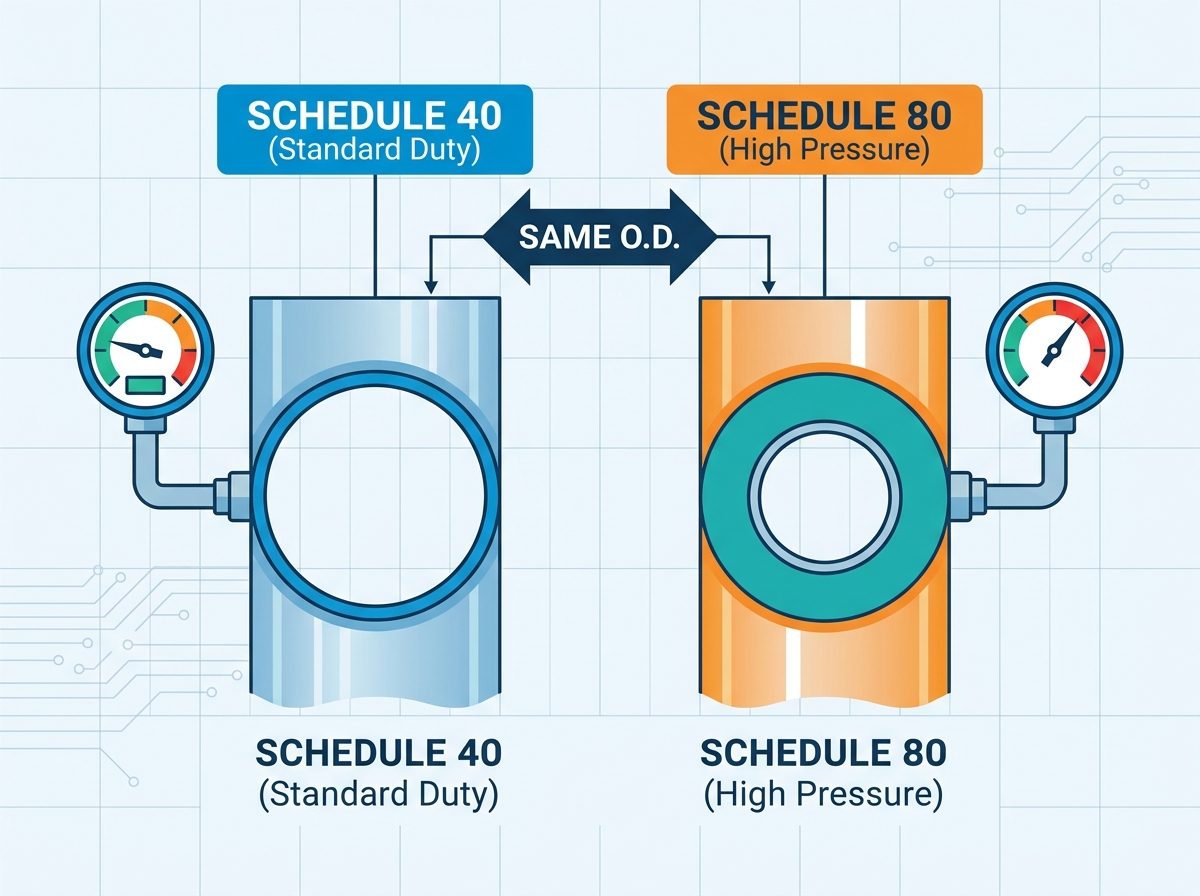
You must match structural integrity to system demands accurately. Proper evaluation prevents dangerous blowouts under pressure. It also stops premature wear from internal abrasion. Wall thickness is categorized globally by the Schedule system. Your operating environment dictates this selection entirely.
Schedule 40 represents the standard weight classification. It works best for general commercial plumbing systems. You can use it safely for low-pressure industrial applications. It remains highly cost-effective for large-scale projects. However, it offers less material buffer against internal erosion. We do not recommend it for highly abrasive fluid transfers.
Schedule 80 indicates an extra heavy wall thickness. It is absolutely mandatory for high-pressure systems. You must use it for structural support applications. It also handles highly corrosive fluid transport exceptionally well. The thicker walls provide crucial extra protection against chemical attacks.
There is a distinct tradeoff to consider here. Thicker walls naturally reduce the internal diameter (ID). This physical reduction impacts overall system flow rates. You may need to perform hydraulic recalculations. Friction loss increases as the internal diameter shrinks.
We must align Schedule selection with maximum operating pressure (MOP). You should also consider expected temperature fluctuations carefully. High temperatures weaken structural integrity slightly over time.
Pipe Schedule Specifications Comparison
Schedule Type | Wall Thickness Level | Internal Diameter Impact | Ideal Application Environments |
|---|---|---|---|
Schedule 40 | Standard / Medium | Maximum flow allowance | Commercial plumbing, low-pressure lines |
Schedule 80 | Heavy / Thick | Reduced flow allowance | High-pressure, corrosive media, structural |
Navigating thread types requires identifying specific regional differences. We must understand precise mechanical variations to ensure hermetic seals. Mixing standards remains a very common industrial error.
NPT stands for National Pipe Thread. It serves as the primary standard across North America. NPT features a distinct 60-degree thread angle. It incorporates flattened peaks and valleys along the profile. The threads taper to wedge tightly together. This wedging action creates a robust mechanical seal.
BSPT stands for British Standard Pipe Taper. It serves as the standard for Europe and Asia. Many global industrial systems rely on it heavily. BSPT features a unique 55-degree thread angle. It incorporates rounded peaks and valleys instead of flattened ones. This geometry requires different manufacturing tooling entirely.
You must evaluate thread quality carefully before purchasing. This shows exactly why specifying a specialized BSPT threaded fittings manufacturer matters immensely. International projects demand exact machining tolerances. Poorly cut threads will leak regardless of the sealant used.
Warning: You face severe risks if you mix these standards. Forcing an NPT male fitting into a BSPT female port guarantees failure. The threads will cross-thread almost immediately upon turning. This mistake results in inevitable leakage under operational pressure. The flattened peaks will gall against the rounded valleys. You will likely destroy both fittings permanently.
You must match alloy composition to chemical realities carefully. Your project environment dictates this metallurgical choice entirely. Proper material selection optimizes long-term system efficiency. We rely on two primary alloy grades in the industry.
304 stainless steel offers high overall versatility. It provides excellent resistance to general atmospheric oxidation. It remains very cost-efficient for standard industrial pipelines. It derives its strength from chromium and nickel additions.
However, it possesses notable chemical drawbacks. It becomes highly susceptible to pitting corrosion rapidly. Chloride-rich environments destroy the passive layer quickly. We strongly discourage using it near coastal environments.
Best for: We recommend 304 for potable water systems. It works perfectly for standard HVAC setups. You can use it confidently for non-aggressive chemical processing applications.
316 stainless steel contains a crucial addition of molybdenum. This element provides superior resistance to harsh chlorides. It handles aggressive industrial solvents exceptionally well. The protective oxide layer remains stable under severe stress. The main drawback involves a moderately higher initial material cost.
Best for: We highly recommend 316 for demanding marine applications. It serves municipal wastewater treatment facilities reliably. Aggressive chemical processing plants mandate this grade continuously. Pharmaceutical processing facilities also require its superior hygienic properties. Proper selection ensures your 304/316 stainless steel pipe fittings last safely for decades.
Shortlisting logic requires evaluating suppliers deeply. You must look far beyond simple unit pricing. High-quality parts demand rigorous manufacturing standards. Partnering with the right facility prevents massive project delays.
Certifications prove a supplier's true technical capability. You should partner exclusively with a certified EN10241 nipple supplier. This specific standard guarantees precise dimensional accuracy across batches. It also ensures strict material integrity from the foundry.
Look specifically for current ISO 9001 certification. You must also request full material test reports (MTRs). These documents verify the exact chemical composition of the steel. They ensure complete batch traceability back to the raw ingot.
Assess their overall manufacturing capabilities carefully. A reliable stainless steel threaded nipple manufacturer produces custom lengths easily. They handle varying pipe schedules without unnecessary production delays. They should offer specific thread types upon your request. This includes right-hand and specialized left-hand orientations. They can also machine customized tapers for unique engineering applications.
Evaluate their supply chain reliability very closely. Check their average quoted lead times for large bulk orders. Analyze their active inventory depth for standard sizes. Review their internal QA/QC testing processes carefully. Proper thread gauging prevents galling-prone defects from reaching your facility.
Sizing a stainless steel nipple correctly demands a holistic evaluation process. You must account for end-to-end length measurements accurately. You must select the right Schedule to manage internal pressures safely. Thread geometry differences between NPT and BSPT require strict attention. Finally, selecting between 304 and 316 grades ensures system longevity.
We advise buyers to consolidate their project specifications thoroughly. Document your required pressure ratings, fluid media, and environmental conditions. Consult directly with a certified manufacturing partner using these exact metrics.
We prompt you to request a detailed sizing chart today. Download a comprehensive technical catalog to review available specifications. Contact an engineering sales team for project-specific sizing and material recommendations.
A: Pipe nipples are always measured end-to-end overall. You must include the threaded sections on both sides in this measurement. You do not measure just the unthreaded center shank. Using a standard tape measure across the entire fitting provides the accurate nominal length.
A: A close nipple is threaded across its entire length. It features virtually no unthreaded pipe in the middle. When two female fittings attach, they nearly touch. A standard nipple has a clearly defined unthreaded shank between the threads. This space allows for easy gripping with standard pipe wrenches.
A: It is highly discouraged. 304 stainless steel is extremely prone to pitting from chlorides. The passive layer degrades quickly. 316 stainless steel is explicitly required for marine and high-chloride applications. Its added molybdenum content protects the metal from rapid corrosive degradation.
A: No. The outside diameter (OD) remains completely identical across different schedules. This consistency ensures they can still mate with standard pipe threads properly. Schedule 80 achieves a thicker, stronger wall strictly by reducing the inside diameter (ID).


